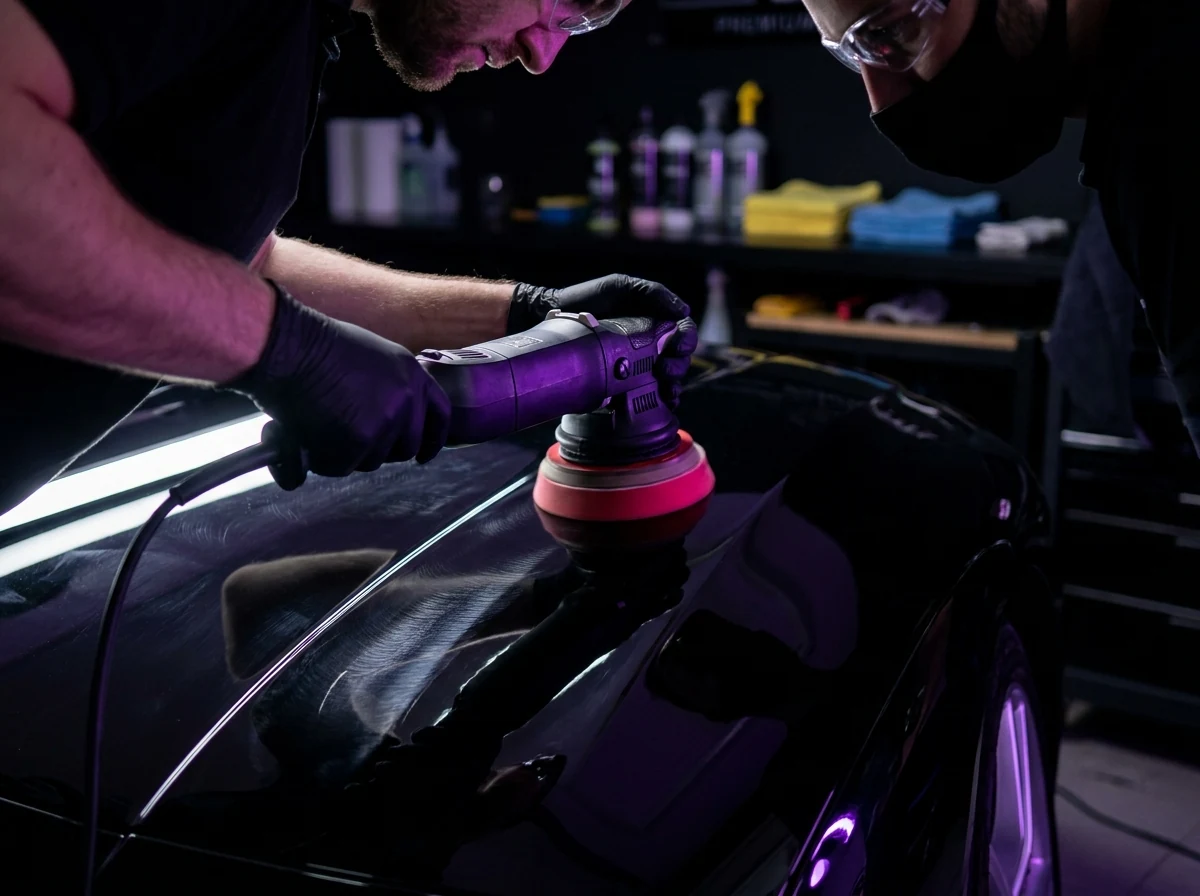
Technician machine-polishing dark automotive paint under violet inspection lighting

Paint correction · Charleston, South Carolina

Clarity, without chasing damage.

Inspection-led paint correction for cars, trucks, and appropriate painted RV panels—using measured polishing stages to improve clarity while preserving the finish.

Custom quote after the finish, vehicle, defects, and goals are reviewed.

Correction, not concealment

The goal is better paint—not thinner paint.

Swirl marks are fine scratches that scatter reflected light. Haze, buffer trails, oxidation, etching, and isolated scratches may sit at different depths.

Machine polishing levels a small amount of the painted surface around a defect. Because clear coat and paint are finite, the plan is the least aggressive process that produces worthwhile improvement—not unlimited cutting.

Defect depth changes the decision

Read the light. Respect the layers.

01

Light marring + haze

Refine before you cut.

Fine wash marring, light machine haze, and shallow swirls may respond to a finishing polish after cleaning and inspection.

  • Focused lighting reveals the pattern
  • A test spot checks paint response
  • The finish is re-inspected after residue removal
02

Heavier visible defects

Stage the work around the paint.

More visible swirls or oxidation may call for a compound step followed by a refining polish. Tool, pad, abrasive, and technique are selected from the finish response.

  • No preset correction percentage
  • More stages are not automatically safer
  • Edges, body lines, and repairs receive added caution
03

Deep or unstable damage

Know when polishing stops.

A scratch through the clear, peeling finish, cracking, checking, exposed base color, or questionable repair may need refinishing instead of abrasion.

  • Deep defects may remain visible
  • Thin or unstable areas may be excluded
  • Preservation takes priority over chasing a defect

The work behind the reflection

Inspect. Test. Measure. Refine.

The plan is established on the vehicle, not from a generic package name.

  1. 01

    Inspect + document

    Identify defect types, prior repairs, edges, failing areas, and other risk factors.

  2. 02

    Wash + decontaminate

    Remove loose soil and bonded contamination before any test polishing.

  3. 03

    Measure + test spot

    Use suitable thickness readings for context, then test a representative area to evaluate paint response.

  4. 04

    Correct in stages

    Adapt the proven combination panel by panel and refine heavier cutting when needed.

  5. 05

    Inspect + protect

    Check the cleaned finish in appropriate light. Ceramic coating may protect prepared paint, but it does not remove defects.

Clear stopping conditions

Some defects should stay.

Correction cannot replace missing paint or make a compromised finish structurally sound.

  • Peeling, cracking, checking, or exposed substrate requires repair
  • Deep scratches, chips, etching, staining, or repair texture may remain
  • Readings add context but do not reveal every layer or previous repair
  • Edges, body lines, decals, matte finishes, and sensitive trim may be excluded

Painted panel or gel coat?

Paint correction is for compatible painted finishes. An RV's oxidized fiberglass or gel coat is a different substrate and restoration problem; visit RV oxidation removal. If an RV panel is painted, we can inspect whether this correction pathway is appropriate.

Before you book

Paint correction, without the mythology.

What is paint correction?+

It is controlled abrasive polishing used to improve correctable defects in a painted finish. The process may use a finishing polish or a compound-and-polish sequence, depending on the paint and test spot.

Will every scratch disappear?+

No. Deep defects and defects in thin or unstable areas may remain or require touch-up or refinishing.

Why inspect and perform a test spot?+

Paint systems, prior repairs, hardness, and defects vary. A test spot shows the improvement and finish quality available from a specific process.

Does a thickness reading guarantee safety?+

No. It is one piece of context considered with substrate, panel shape, history, visual inspection, and the test spot.

Should correction come before ceramic coating?+

If correctable defects are to be improved, that work happens before coating. Coating does not level scratches or repair failed paint.

Is RV paint correction the same as RV oxidation removal?+

Not always. Painted RV panels may be assessed for correction; oxidized fiberglass or gel coat follows a different restoration pathway.

Start with the finish in front of us

Build the plan from evidence.

Share your vehicle and finish concerns. We will determine whether photos are enough to begin or an in-person inspection and test spot is needed.